


ANA GISELE OZAKI is an architectural historian and Assistant Professor of Modern and Contemporary Architectural History at the University of Pennsylvania. Her research examines transoceanic circulation across Brazil, Africa, and the wider Atlantic world, rethinking modern architecture through questions of climate, labour, domesticity, and colonial governance.
On Friday, her lecture The Brazilian Atlantic positions the Brazilian Atlantic as an architectural terrain shaped by trans-Atlantic movement, traveled unevenly from Brazil into West and Southern Africa. It detailed how the architectural forms, spatial practices, and climatic techniques linked to Brazil’s plantation worlds, were eventually reworked back into Nigeria and Angola, by both Afro-Brazilian returnees and Portuguese colonial architects as tools of social recognition and governance. Read through a Black feminist lens, Ozaki reveals how the ‘new Brazils’ ideals of architectural futurity and romanticized legacies of the colonial plantation stood as a modern model of tropical acclimatisation, hybridity, and racial miscegenation for frameworks of territory, nation, colony, and self.
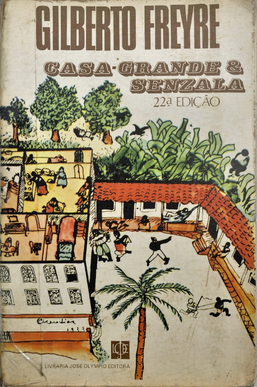
Gilberto Freyre, Casa-Grande & Senzala, 1933.
The lecture was framed through a critical position towards the work of Gilberto Freyer, a Brazilian sociologist influential for his ideas on Brazil’s racial democracy, alongside Stefan Zweig’s portrayal of post-war Brazil as a ‘Land of the Future’. Where much of colonial historical literature framed 19th-20th century Brazil as a free and unsuppressed racial paradise, Ozaki reexamines this narrative of democracy and modern progress through an analysis of the architectural forms which had emerged during this time. Through a series of archival images, Ozaki details how Brazil’s colonial plantation and slave logics were not abolished but rather adapted to a ‘post-white’, racially ambiguous ‘new Brazil’, through domestic layouts, verandahs, urban morphologies, and service infrastructures.
Ozaki further entangles the topic of miscegenation with the power dynamics of bodily extraction. Referencing a portrait of Augusto Gomes Leal and wet nurse Mônica, she highlights the dependencies and relations present across different the racial roles. While the architecture of ‘new Brazil’ was informed by logics of the plantation, the ‘inner space’ of wet nurses, roles typically fulfilled by black women, was likewise seen as a form of ‘plantation machine’. Where the milk provided by wet nurses were resources consumed by racial elites, the black female body was “portrayed as part of, and an extension of the public space of colonial domestic architecture”.
Afterwards, the QnA consisting of the faculty and student attendees raised discussion on some main themes.
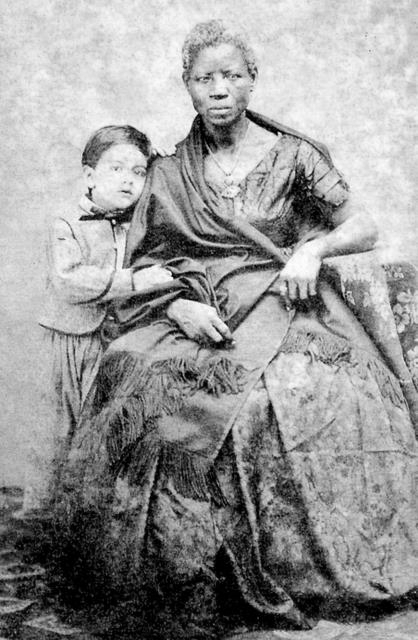
João Ferreira Villela's portrait of Augusto Gomes Leal and wet nurse Mônica, Recife, Brazil, c. 1860.
Several key questions by Robin and Jane were centered around the tension between the narrative of racial democracy, and the lived reality of persisting power structures. To what extent was there an awareness of this irony? Ozaki responded that with the ideal of ‘new Brazils’, there was a layer of colonial nostalgia that turned the perception of colonial violence into a ‘softer’ form of control. At the same time, the colonial mindset largely saw the tropics as a project to be solved through ‘progressive whitening’. Therefore, although Afro-Brazilians had long been critical of the racial democracy myth, its claim to a modernist progression was likely not seen as paradoxical in its time. Additionally, Ozaki’s response to Jiat Hwee’s question on the ‘new Brazils’ deployment of Afro-Brazilian architectural devices, emphasised again the irony that many of these adaptations were in reality “fictions and performative fashions”, meant to resemble “Brazilian-ness” while at the same time maintaining labour and power structures.
On the topic of grappling with the complexity of this history, Ozaki also mentions alternate forms of racial democracy, such as ‘Quilombo thinking’, an Afro-Brazilian philosophy of resistance. Saptarshi's comment towards the portrait, reflecting on colonial ideals of comfort and the function of wet nurses as a maternal resource, once again connects the organizational logics of territory and land back to fundamental power over bodies.
The Brazilian Atlantic: Architectural Circulation, Return, and Translation has been hosted and supported by the National University of Singapore Department of Architecture. We are thankful to our organisers, participants, and audience. The event was organised and publicised by the Laboratory of Architectural & landscape architectural Histories & humanities.
