

Written by Saptarshi Sanyal
Published in The Journal of Architecture; Forthcoming; Accepted for publication: January 2026.
In societies under colonial rule, self-taught builders or designers far outnumbered architecture or engineering professionals. Yet, their practices continue to remain largely absent from architectural histories, owing to overwhelming archival silences. This article investigates the practice of Surendranath Kar (1892–1970), one such self-taught architect in twentieth-century colonial India. Kar, a deeply reticent and self-effacing personality himself, seems never to have recorded his ideas, nor left behind any kind of architectural documents. Through his own silence, that about his work, and an absence of records, Kar might appear as an architect, incognito. Yet, piecing together voices of those touched by his role as an artist-educator at Santiniketan, the site of a highly experimental educational project in eastern India, reveals Kar’s novel modes of shaping spaces through building alterations, art pedagogy and scenography. Moreover, using drawing as a research method shows important nuances within Kar’s diverse built projects, spanning institutional structures to dwellings, indicating a more autonomous manner of thinking and doing as an architect-builder. By thus re-assembling Kar and his practice, this article underscores how architecture is produced, often silently, at the building site rather than the architect’s atelier—thereby engaging with the still-unresolved questions of architectural authorship in our historical field.
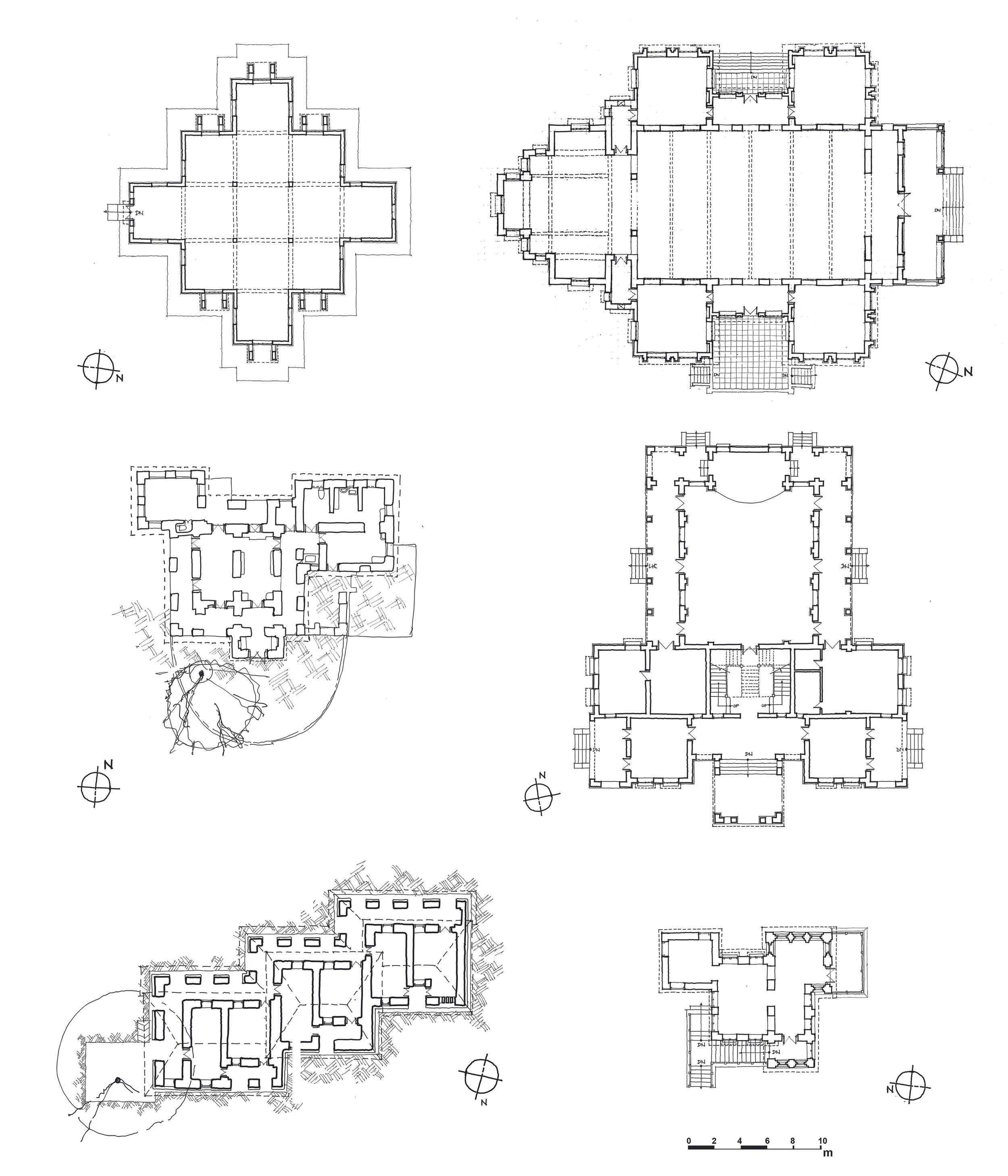
Ground plans of structures Kar built in a single stretch of time between 1921 and 1939; drawing by the author (2020).